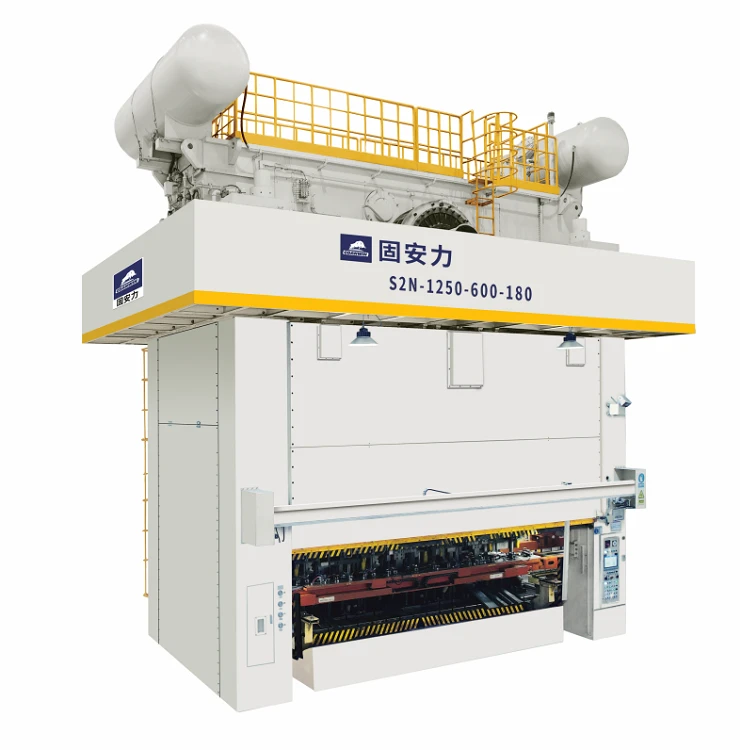
Choosing a Stamping Press: Frame, Tonnage and Bed Size
A stamping press enquiry is read against the manufacturer's published range as a whole: the frame family and its published dimensions — deflection behaviour, die access and the longest die the family is documented for — alongside the numbers: capacity at the rated tonnage point, stroke, strokes per minute, bolster area and die height. This page sets out both parts against the published tables, with no order of priority between them. For the drive-side catalogue, go to mechanical presses; for whole-line equipment, go to metal stamping machines.
The Frame
- C-frame (gap frame) — open on three sides; published from 15 to 400 tons (C1N). The C1N page documents stamping small parts and progressive die operation.
- Straight side, single crank — closed box frame; D1N (80-260 t) and M1N (125-800 t). Suits deeper drawing, bending, marking, flattening and trimming work in one press (M1N documented applications).
- Straight side, two-point — the slide is driven at two points and guided on six-point box gibs or eight-side rails; D2N (110-800 t) and T2N (400-1,200 t). Suits long, narrow parts and long multi-station dies.
- Straight side eccentric, four-point — S2N (400-1,600 t) for large dimension dies run left-to-right and front-to-back, progressive or transfer, including large odd-shaped and deep-formed parts.
- Servo straight side / C-frame — EM2 (110-630 t) and EC1 (25-315 t) when the forming curve itself is the variable; see servo presses.
The Numbers That Matter
| Check | Why it matters | Published span in this range |
|---|---|---|
| Capacity & rated tonnage point | Full force is only available at the rated point above BDC; thick or high-strength material needs the point checked, not just the headline tonnage | 15-2,000 t overall; rated points 1-13 mm by model |
| Bolster area vs die footprint | The die must sit on the bolster with clamping room | 680 x 300 mm (C1N-15) to 6,000 x 1,800 mm (S2N-1600) |
| Stroke length | Must clear the formed part and the feed; deep-drawn parts need long strokes | 10 mm (GT knuckle joint) to 700 mm (S2N) |
| SPM range | The press's own stroke rate; parts per minute also depends on the parts produced per stroke, and on your feeder and die | 1 SPM (EC1 servo at its slowest setting) to 2,000 SPM on the GT-15H (the smallest GT knuckle joint model); crank and high-speed models start at 10 SPM (M1N-800 — a presumed restoration of a date-printed cell, see the mechanical press page) |
| Die height & adjustment | Your die's shut height must fall inside the range, with adjustment left for sharpening | Adjustment 50-500 mm depending on series |
| Press weight & foundation | The heaviest catalogue models run to tens of tons; the A1 table publishes 1.9-30 t across its models | Confirm per model in the quotation |
Worked Selection Examples (from the published tables)
- Two-point frames at 250 t: the C2N-250 is tabled in a gap frame — bolster 2,700 x 900 mm, stroke 280 mm in the V variant — and the C2N page documents progressive dies that need the longer bed area; the D2N two-point straight side series documents long dies with multiple stations.
- Motor laminations: the GP series is the manufacturer's stated motor lamination series — GP-220T runs 150-450 SPM with a 1,900 x 1,000 mm bolster plate; see the high-speed page.
- High-tensile automotive part: the EM2 servo page documents suitability for high-tensile strength steel and in-die secondary operations. For a crank-press reading of the same part, state the material and thickness in the enquiry; the fit is confirmed in the quotation.
- C1N-60, as tabled on the C-frame page: 120 / 50 mm stroke options (V / H), 100-150 SPM in the H variant, die cushion 3.6 t. The C1N page documents stamping small parts at high single-stroking rates or in continuous mode, using either blanks or coil stock.
Frequently Asked Questions
How is press tonnage rated?
By the capacity available at the rated tonnage point — the distance above bottom dead centre stated in each model's table (for example 3.2 mm on a C1N-45 V variant). Where a job needs force higher above BDC, that requirement is read against each model's published rated tonnage point; state the material and thickness in the enquiry.
C-frame or straight side for a progressive die?
The C1N page documents progressive die operation on its gap frame range, and the C2N documents progressive dies needing a longer bed area. Long dies are read against the straight side frames (D2N, T2N, S2N) — the series documented for long multi-station dies. For thick or high-strength stock, state the material and thickness in the enquiry; which series fits a given die and material is confirmed in the quotation.
Can the same press run transfer and progressive dies?
The S2N and T2N pages document both progressive and transfer die operation, including parts that need a transfer system to move through the die. The C2N documents progressive dies needing a longer bed area.
What if my die is bigger than any catalogue bolster?
The manufacturer states its presses can be customized for bed and other dimensions. Send the die footprint and the customization is answered in the quotation.
Send an Enquiry
Tell us the machine, your material and thickness, and the part you are forming. Tonnage, configuration and price are confirmed in the written quotation.