Five High-Speed Families, Five Different Jobs
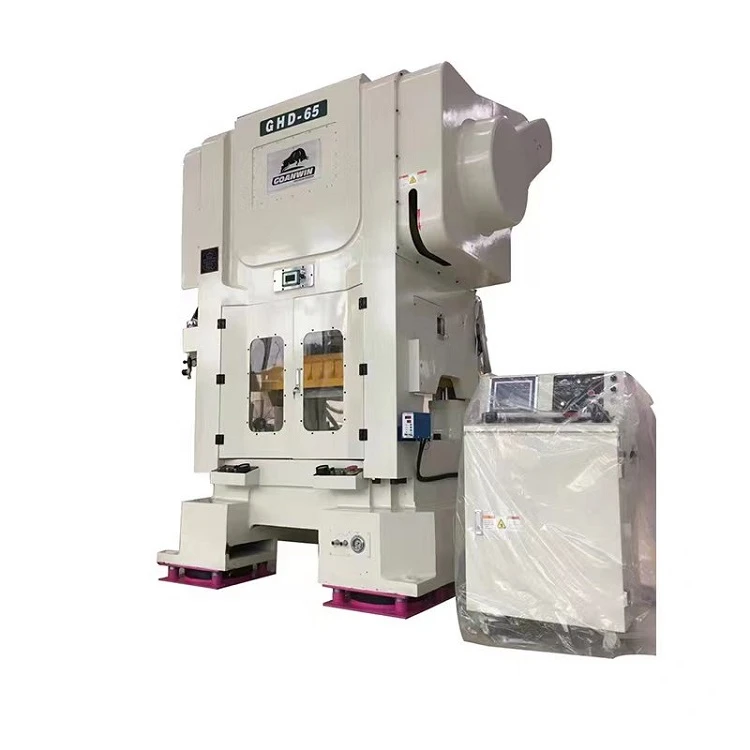
High-speed pressing is not one machine made faster; it is five families tuned to different parts. The GHD (30-65 t) is a four-column H-frame machine for small precision parts in thin material; the GS C-frame (30-80 t) is the economical small-parts machine; the GP (85-550 t) is the motor lamination press with a bolster plate sized for lamination dies; the GPH (45-300 t) is built for motor cores in sheet thinner than 0.5 mm; and the GT knuckle joint press (150-1,500 kN), documented for lead frames and precision electronic parts in thin material, reaching up to 2,000 SPM on the GT-15H. Every speed below is a maximum for a stated model variant — high-speed presses are always quoted against the part, the die and the material.
GHD H-Frame High-Speed Press — Published Technical Data
| Model | Capacity (t) | Stroke options (mm) | SPM by stroke option | Die height by stroke option (mm) | Slide area (mm) | Bolster area (mm) | Motor (kW) |
|---|---|---|---|---|---|---|---|
| GHD-30 | 30 | 20 / 25 / 30 / 40 | 200-1000 / 200-900 / 200-800 / 200-600 | 195-235 / 192-232 / 190-230 / 185-225 | 620x340 | 650x470x100 | 7.5 |
| GHD-45 | 45 | 20 / 25 / 30 / 40 | 200-900 / 200-800 / 200-700 / 200-600 | 230-280 / 227-277 / 225-275 / 220-270 | 750x380 | 800x550x120 | 11 |
| GHD-65 | 65 | 20 / 30 / 40 / 50 | 200-800 / 200-600 / 200-500 / 200-400 | 275-325 / 270-320 / 265-315 / 260-310 | 900x450 | 950x700x135 | 18.5 |
The GHD page documents a one-piece cast iron straight side frame for stability and stamping precision, better eccentric loading capacity than a C-type frame, and a forced lubrication system with oil cooling that minimises thermal deformation. Speed depends on the stroke selected: the shortest stroke on the GHD-30 reaches 1,000 SPM.
GS C-Frame High-Speed Press — Published Technical Data
| Model | Capacity (t) | Stroke A/B/C (mm) | SPM A/B/C | Die height A/B/C (mm) | Slide area (mm) | Bolster area (mm) | Motor (kW) |
|---|---|---|---|---|---|---|---|
| GS-30 | 30 | 20 / 30 / 40 | 200-700 / 200-600 / 200-500 | 215 / 210 / 205 | 330x225 | 600x330x80 | 3.7 |
| GS-45 | 45 | 20 / 30 / 40 | 200-700 / 200-600 / 200-500 | 245 / 240 / 235* | 420x320 | 720x450x90 | 5.5 |
| GS-65 | 65 | 30 / 40 / 50 | 200-600 / 200-500 / 200-400 | 255 / 250 / 245 | 540x350 | 900x525x100 | 11 |
| GS-80 | 80 | 30 / 50 / 60 | 200-600 / 200-500 / 200-400 | 360 / 350 / 345 | 600x400 | 1000x590x120 | 15 |
The manufacturer's GS table prints a second SPM row (GS-30: 200-900 / 200-800 / 200-600; GS-45: 200-800 / 200-700 / 200-600; GS-65: 200-700 / 200-600 / 200-500; GS-80: 200-700 / 200-600 / 200-500); the table itself does not state what distinguishes the two rows, so no reason is claimed here — the table above gives the first published set, and which set applies to a given configuration is confirmed in the quotation. One figure in the table above is normalised: the manufacturer's table prints the GS-45 third die height as “2235”, read here as 235 mm (marked * in the table above), in line with the 245 / 240 values beside it and the descending pattern of the other models' rows; treat 235 as a presumed correction of a misprint and have it confirmed by the manufacturer when quoting. The GS is the open-frame member of the high-speed line, documented for electric motor and generator work — buttons, eyelets, terminals, and stator and rotor plates — with a roller or NC servo feeder fitted per the line configuration; see the feeding line page.
GP H-Frame High-Speed Press — Published Technical Data (Motor Laminations)
| Model | Capacity (t) | SPM | Stroke (mm) | Die height (mm) | Slide plate (mm) | Bolster plate (mm) | Main motor (kW) |
|---|---|---|---|---|---|---|---|
| GP-85T | 85 | 200-500 | 30 | 330-380 | 1100x500 | 1100x750 | 22 |
| GP-125T | 125 | 150-500 | 30 | 360-410 | 1400x600 | 1400x850 | 37 |
| GP-160T | 160 | 150-500 | 30 | 360-410 | 1600x600 | 1600x900 | 37 |
| GP-220T | 220 | 150-450 | 30 | 370-420 | 1900x700 | 1900x1000 | 45 |
| GP-300T | 300 | 100-350 | 30 | 400-450 | 2300x900 | 2300x1000 | 55 |
| GP-350T | 350 | 100-300 | 30 | 400-450 | 2500x900 | 2500x1000 | 55 |
| GP-400T | 400 | 100-300 | 30 | 450-500 | 2800x1000 | 2800x1200 | 75 |
| GP-450T | 450 | 100-300 | 30 | 450-500 | 3000x1000 | 3000x1200 | 75 |
| GP-550T | 550 | 60-260 | 30 | 480-530 | 3300x1100 | 3300x1200 | 90 |
The GP page states the application directly: stacked stator and rotor cores for AC and DC motors, with a high-strength cast iron frame and an excellent dynamic balance design that minimises vibration and noise and ensures the life of both press and stamping die. The lamination process itself — slit coil, notching, stacking — is covered in the motor lamination guide.
GPH H-Frame High-Speed Press — Published Technical Data
| Model | Capacity (t) | SPM | Stroke (mm) | Die height (mm) | Slide plate (mm) | Bolster plate (mm) | Main motor (kW) |
|---|---|---|---|---|---|---|---|
| GPH-45T | 45 | 150-700 | 30 | 240-290 | 750x380 | 750x550 | 15 |
| GPH-65T | 65 | 150-700 | 30 | 300-350 | 950x420 | 950x650 | 19 |
| GPH-85T | 85 | 150-700 | 30 | 330-380 | 1100x500 | 1100x750 | 22 |
| GPH-125T | 125 | 150-700 | 30 | 360-410 | 1400x600 | 1400x850 | 37 |
| GPH-220T | 220 | 150-500 | 30 | 370-420 | 1800x700 | 1800x950 | 45 |
| GPH-300T | 300 | 150-450 | 30 | 400-450 | 2200x900 | 2200x1000 | 55 |
The GPH runs a 30 mm stroke throughout the family and is documented for motor cores in sheet thinner than 0.5 mm — the classic electrical steel band — with better precision than the GP for that work, per the manufacturer's page.
GT Knuckle Joint High-Speed Press — Published Technical Data
| Model | Capacity (kN) | Stroke options (mm) | SPM by stroke option (as published) | Die height by stroke option (mm) |
|---|---|---|---|---|
| GT-15H | 150 | 10 | 200-1800 (2000) | 220 |
| GT-30 | 300 | 20 / 25 / 32 | 200-1200 / 1050 / 900 | 240 |
| GT-40 | 400 | 20 / 25 / 30 / 32 | 180-1000 / 900 / 550 / 850 | 240 |
| GT-40W | 400 | 20 / 25 / 32 / 40 | 180-850 / 800 / 700 / 700 | 240 / 240 / 240 / 235 |
| GT-60 | 600 | 20 / 25 / 32 | 100-750 / 750 / 650 | 300 |
| GT-60W | 600 | 25 / 32 / 40 / 45 / 50 | 100-700 / 600 / 450 / 400 / 350 | 340 / 340 / 335 / 325 / 320 |
| GT-80 | 800 | 20 / 25 / 32 / 36 | 120-700 / 600 / 550 / 500 | 320 |
| GT-80W | 800 | 25 / 32 | 120-500 / 450 | 320 |
| GT-125 | 1,250 | 25 / 36 | 100-400 / 350 | 350 |
| GT-125S | 1,250 | 25 / 36 | 100-600 / 400 | 350 |
| GT-150 | 1,500 | 30 / 36 | 100-400 / 350 | 350 |
The GT knuckle joint press is the repeatability specialist: stroke options from just 10 mm (GT-15H) up to 50 mm, and a documented die-life benefit — the interval between die regrinding runs more than 25% longer than on a conventional crank press, per the manufacturer's page — because the knuckle joint offsets thermal displacement and holds bottom dead centre steady. Its documented work: lead frames in semiconductors and EV motor laminations. The manufacturer's page adds that the link slide motion gives more time at the bottom of the stroke, for better part forming performance.
Frequently Asked Questions
Which high-speed press for motor laminations?
The GP series is documented for stacked stator and rotor cores (85-550 t, 60-500 SPM across the family). For motor cores in sheet thinner than 0.5 mm, the GPH covers 45-300 t at 150-700 SPM. Send the lamination diameter, stack height and material thickness with the enquiry.
What is the fastest press in the range?
The GT-15H knuckle joint press, published at 200-1,800 SPM (2,000 in the table's notation) at 150 kN capacity and a 10 mm stroke — a small-parts machine, not a general press.
Can high-speed presses run progressive dies?
The high-speed pages state each family's documented work in its own terms — motor lamination on the GP and GPH, lead frames and EV motor laminations on the GT — rather than as a progressive-die statement covering the families. The die itself is buyer-side tooling; the press is configured for its height, and the feed pitch for a given die is confirmed with the die in the quotation.
Why does the knuckle joint design extend die life?
Per the manufacturer, the GT's knuckle structure offsets thermal displacement and minimises bottom dead centre fluctuation, so the interval between die regrinding is more than 25% longer than on a conventional crank high-speed press — fewer regrinds, longer die life on lead frame work.
Send an Enquiry
Tell us the machine, your material and thickness, and the part you are forming. Tonnage, configuration and price are confirmed in the written quotation.