Why Laminations Are a High-Speed Problem
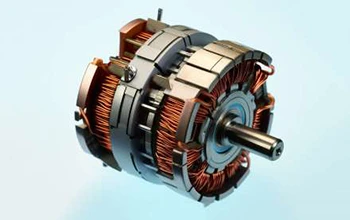
An electric motor's rotor and stator cores are not machined — they are stacks of hundreds of thin electrical-steel laminations, each stamped with the full slot profile in one stroke. A mid-size motor core can need several hundred identical laminations; a production run needs millions. Those volumes are why lamination stamping lives on high-speed presses: this manufacturer's GP series is documented directly for stacked stator and rotor cores for AC and DC motors, at 85-550 tons and 60-500 SPM, and its GPH series covers motor cores in sheet thinner than 0.5 mm. This guide explains what the press must hold at those speeds — and why an ordinary press run fast is not the same machine.
The Process: Slit Coil to Stacked Core
Electrical steel arrives as slit coil, typically a few tenths of a millimetre thick. A decoiler and feeder present it to a progressive lamination die in the press: the die punches the slot profile, the shaft hole and the outer contour in sequence, and — in interlocking (self-clinching) dies — dimples each lamination so the stack locks together as it is built in the die, emerging as a finished core. Every element of that chain has to keep pace with the stroke rate — pilot registration in the die, fed by servo or precision roll feeders.
What the Press Must Hold at Speed
- Dynamic shut-height stability — the high-speed pages document the measures their frames take at speed: the GHD's one-piece cast frame is published for stability and stamping precision, and its forced lubrication system with oil cooling minimises thermal deformation.
- Bolster flatness and size — the GP tables publish bolster plates from 1,100 x 750 mm (GP-85T) to 3,300 x 1,200 mm (GP-550T); the lamination die sits on that plate for its whole life, and its size grows with motor frame size.
- Repeatable bottom dead centre — the same requirement the GT knuckle joint page answers for lead frames with a documented die regrinding interval more than 25% longer than a conventional crank press.
- Feed synchronisation — the feeder, the die's pilots and the press stroke are one timing system; the feeding equipment documented with these presses (NC servo feeders, roll feeders, 3-in-1 lines at ±0.15 mm under a 500 mm feeding length); the feed pitch for a given die is confirmed with the die in the quotation.
The GP and GPH Ranges in Figures
| Series | Capacity | SPM | Documented work |
|---|---|---|---|
| GP-85T to GP-550T | 850-5,500 kN | 60-500 | Stacked stator and rotor cores for AC and DC motors |
| GPH-45 to GPH-300 | 450-3,000 kN | 150-700 | Motor lamination — stacked rotors and stators, sheet thinner than 0.5 mm |
| GHD-30 to GHD-65 | 300-650 kN | 200-1,000 | Small precision parts in thin material |
| GT-15H to GT-150 | 150-1,500 kN | 100-1,800 (2,000 on the GT-15H) | Lead frames and EV motor laminations — the same thin-stock discipline as laminations |
Below the high-speed families sits the same factory's standard crank range (C1N to 400 tons, to 200 SPM), documented for stamping small parts. Which range a lamination job is quoted on is an enquiry question: send the lamination diameter, stack height, material thickness and annual volume with the enquiry. The press families are tabled on the high-speed press page, and the die-side background is in the progressive die stamping guide.
Quality Checks That Matter on Laminations
Burr height is the headline measurement — it is checked against the sheet thickness, not against an absolute number. Stack height and interlock integrity come next (the clinch dimples are formed in the die, so stack quality is press-and-die quality), then lamination flatness. A lamination line is therefore bought as a system — press, feeder accuracy, die quality — and the quotations that work are the ones that specify all three together.
Frequently Asked Questions
What press tonnage does a lamination die need?
Tonnage sizing for a lamination die is your toolmaker's calculation, worked from the core drawing. The press side of the check is the published range: the GP series spans 850-5,500 kN across motor frames from small appliance motors to large industrial motors. Send the lamination drawing and material thickness with the enquiry.
Why not run a standard press faster?
The standard crank range is published to 200 SPM. The high-speed families are separate constructions — GHD, GS, GP, GPH and GT — with their own published frames, guidance and drive arrangements, tabled on the high-speed press page.
What sheet thickness do lamination presses handle?
The GPH series is documented for sheet thinner than 0.5 mm — the classic electrical steel band. The GP series covers the general lamination range; exact thickness windows are confirmed per model and die in the quotation.
Does the factory supply lamination dies?
No — it manufactures the presses and feeding lines. Lamination dies are designed around your core geometry by your toolmaker; the die's dimensions and pitch are read against the published bolster and die height figures in the quotation.
Send an Enquiry
Tell us the machine, your material and thickness, and the part you are forming. Tonnage, configuration and price are confirmed in the written quotation.