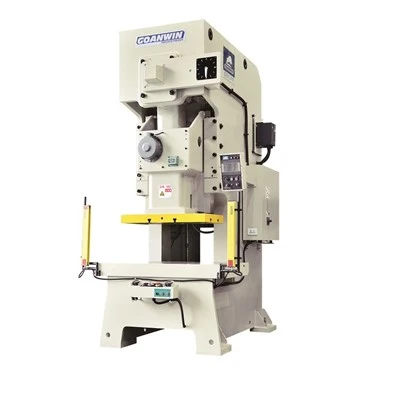
Mechanical Press Series and Published Specifications
The mechanical range is the manufacturer's core line: crank-driven presses in gap (C-frame) and straight side (H-frame and D-frame) constructions, from the 15-ton C1N for small parts to the 1,600-ton S2N four-point eccentric press for large transfer dies. The features repeated across the official product pages define the family: a high-torque, low-noise clutch and brake; a rigid frame with low deflection; high-accuracy transmission gears and a high-rigidity crank; a forced lubrication system with monitoring; and, on most series, a fast-response hydraulic overload protection system that relieves an overload, stops the press immediately and protects press and dies. Published precision is stated per series: the C1N, C1S, D1N and M1N tables give GB (JIS) Class 1, the D2N table gives GB/JIS without a class, and the A1, S2N and T2N tables carry no precision-grade row.
| Series | Construction | Capacity | Stroke | SPM |
|---|---|---|---|---|
| C1N | C-frame single crank | 15-400 t | 30-300 mm | 20-200 |
| A1 | C-frame single crank | 25-315 t | 30-250 mm | 20-190 |
| C1S | C-frame deep throat | 45-160 t | 80-200 mm | 20-100 |
| C2N | C-frame two-point | 110-315 t | 110-280 mm | 20-100 |
| D1N | Straight side single crank | 80-260 t | 70-250 mm | 20-120 |
| D2N | Straight side two-point | 110-800 t | 110-350 mm | 15-110 |
| M1N | Straight side single crank | 125-800 t | 80-300 mm | 10-90* |
| S2N | Straight side eccentric (four-point) | 400-1,600 t | 500-700 mm | 12-30* |
| T2N | Straight side two-point | 400-1,200 t | 300-450 mm | 15-40 |
Ranges above are the span of the manufacturer's published Technical Datas tables for each series; the exact figure for a given model is on the family pages — C-frame and H-frame — and in the downloadable-style specification extracts reproduced there. The two ranges marked * each span a model whose published cell is printed as a date (the M1N-800 and the S2N-1600 second option); the end figures are presumed restorations of those cells — treat them as presumed, not as resolved specifications, and have them confirmed by the manufacturer when quoting.
Gap Frame or Straight Side?
The C-frame (gap frame) series — C1N, A1, C1S and C2N — leave the die area open on three sides. The series pages document blanking, punching, bending and forming of small single pieces of thin plate, and the feeding of coil stock. The C1S deep throat variant lengthens the throat — the distance from plate centre to frame — up to 1,300 mm for wide sheet and perforated products. The straight side series close the frame into a box: D1N and M1N single crank presses, D2N and T2N two-point presses and the S2N eccentric press. The documented work differs series by series: the D1N page documents small parts, the M1N page drawing, bending, marking, flattening and trimming, the D2N page progressive dies on long dies with multiple stations, and the T2N and S2N pages large dimension dies run in both directions, progressive or transfer.
Drive Details Buyers Ask About
- V and H variants: the published tables list V and H variants of many models with different standard SPM and stroke combinations. State your target output with the enquiry; the published tables list the V and H combinations model by model.
- Slide guidance: two-point presses (C2N, D2N) use six-point, full-length box-type gibs; the S2N and T2N use eight-side long guide rails.
- Die cushions: pneumatic die cushions are published across the crank range — for example 2.3 to 14 tons on the C1N series and twin-cylinder cushions up to 14 x 2 tons on the D2N.
- Overload protection: the fast-response hydraulic overload system is a standard feature on the C1N, C1S, C2N, D1N, D2N, M1N, S2N and T2N pages — it relieves tonnage overload pressure and stops the press before the die is damaged.
- Automation compatibility: the electric control system is designed for automation compatibility, and the product pages document connection with single presses, progressive dies, mechanical arms and transfer systems.
For application-first selection — which press for punching, blanking and forming work — see the punch press page; for the model-selection method itself, see stamping presses. Servo and hydraulic alternatives are on their own pages: servo presses and hydraulic presses.
Frequently Asked Questions
What is the largest mechanical press in the range?
The S2N straight side eccentric press, published at 400 to 1,600 tons nominal pressure (4,000 to 16,000 kN), with slide and bolster areas up to 6,000 x 1,800 mm and stroke lengths of 500 to 700 mm.
What precision class are the presses built to?
The manufacturer's Technical Datas tables state GB (JIS) Class 1 precision for the C1N, C1S, D1N and M1N series. The D2N table states GB/JIS precision without a class; the A1, S2N and T2N tables carry no precision-grade row.
Can SPM and stroke be changed from the catalogue values?
Yes — the product pages state the presses can be customized for a wider range of SPM, stroke, rating point (BDC), bed and other dimensions. The changed figures are fixed in the quotation, not after the order.
Do the presses support progressive dies and transfer systems?
Yes. The C1N page documents single-press, progressive die, mechanical arm and transfer system connection. Series by series: the C2N and D2N pages document progressive dies; the T2N and S2N pages document progressive and transfer dies.
Send an Enquiry
Tell us the machine, your material and thickness, and the part you are forming. Tonnage, configuration and price are confirmed in the written quotation.