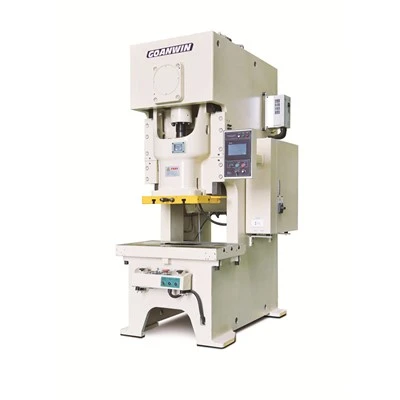
Punch Press Work: Blanking, Punching, Bending, Forming
In this manufacturer's catalogue, the punch press is a crank press applied to punching work: blanking, punching, bending and forming of thin steel plate and small parts, in the official wording of the A1 and C1N product pages. The machines run at high single-stroking rates or in continuous mode, fed with blanks or coil stock. Choosing one is a matter of matching the die, not just the tonnage: die height, slide adjustment, shank hole, bolster area and die cushion all appear in the published tables, and all of them decide whether your tooling fits.
The Punch Press Families
- C1N C-frame mechanical press (15-400 t) — the general-purpose punching press of the range, documented for stamping small parts from blanks or coil, with hydraulic overload protection and GB (JIS) Class 1 precision.
- A1 C-frame single crank press (25-315 t) — documented for blanking, punching, bending and forming on small single workpieces of thin plate and progressive die parts.
- C2N C-frame double crank press (110-315 t) — two-point drive and a long bed (bolster up to 2,700 x 900 mm) for long, narrow parts and multi-station progressive dies.
- C1S deep throat press (45-160 t) — throat depth options up to 1,300 mm for wide sheet and perforated products that a standard gap frame cannot swallow.
- High-speed families (GS, GHD, GP, GPH, GT) — for small precision punching at 60 to 2,000 SPM across the published tables — the 2,000 SPM peak is the GT-15H's — the exact figure depending on family, model and configuration: terminals, eyelets, lead frames and motor laminations; see the high-speed press page.
Tooling Interface: The Figures That Decide Fit
| Interface | Published range (mechanical crank range) |
|---|---|
| Shank hole | Ø38.1 mm (small C-frame models) to Ø70 mm (C1N-400, A1-315) |
| Die height adjustment (slide adjustment) | 50-150 mm on the C-frame and smaller straight side series; 150-300 mm on the T2N; 200-500 mm on the S2N |
| Die cushion capacity | 2.3-16 tons pneumatic cushions, model dependent (C1N, A1, C2N, D1N and D2N tables; twin-cylinder cushions to 14 x 2 tons on the C2N and D2N) |
| Rated tonnage point | 1-13 mm above BDC, per model — the height at which full rated force is available |
| Bolster area | 680 x 300 mm (C1N-15) to 6,000 x 1,800 mm (S2N-1600) |
A note on tooling supply: this manufacturer builds presses, not punching dies. Dies are normally designed around your part drawing; what the factory needs from you is the part, the material and its thickness, and the die dimensions, so the press can be configured for your die height, bolster footprint and stroke. The buying-side method is covered in the punch press tooling guide.
Modes and Automation
The official pages document single-stroke and continuous operation, with feeding by blanks, coil stock, mechanical arm or transfer system, and progressive dies where the part allows it. Combined with a coil feeding line — decoiler, straightener and servo feeder under one control — a C1N or C2N becomes a complete punching cell; the electric control system of the presses is designed for that automation compatibility. For parts that need a controlled forming curve instead of a crank curve, the servo press range covers 25 to 630 tons with programmable slide profiles.
Frequently Asked Questions
What information do you need to quote a punch press?
The part drawing or dimensions, material grade and thickness, target strokes per minute, and the die size (or the die height and bolster footprint if the die exists). Those are the details to send with the enquiry; the written quotation states the model, variant and options.
Can one press run several different dies?
Yes, within the published die height and slide adjustment range of the model. The adjustment figures are in the tables on the mechanical press page; dies taller than the range fall outside that model's published die height range.
Do you supply the punching dies as well?
The factory manufactures presses and feeding equipment. Punching and forming dies are buyer-side tooling designed around the part; the press is configured to your die's height, shank and bolster requirements.
What protects the die if the press is overloaded?
Most crank series carry a fast-response hydraulic overload protection system as a standard published feature: it relieves the overload pressure, stops the press immediately and protects the press and the dies from damage.
Send an Enquiry
Tell us the machine, your material and thickness, and the part you are forming. Tonnage, configuration and price are confirmed in the written quotation.