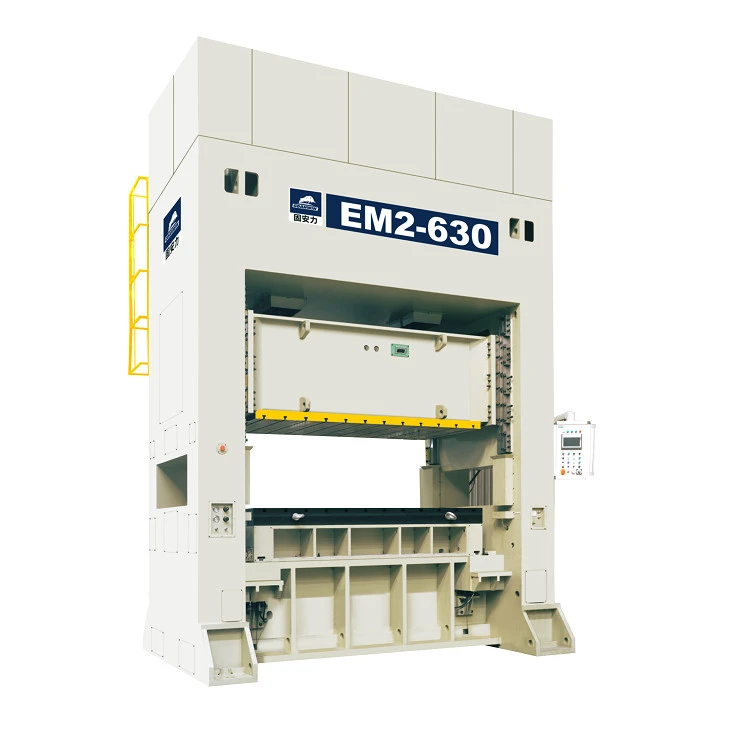
Two Servo Families: EC1 C-Frame and EM2 Straight Side
The servo range replaces the flywheel and clutch of a crank press with a direct servo drive whose slide motion is programmable. The manufacturer publishes two families: the EC1 C-frame servo press (25-315 tons) for small and medium parts, and the EM2 straight side servo press (110-630 tons) for large parts and high-tensile work. The documented advantages are stated plainly on the product pages: on the EC1 page, a progressive die combined with a pendulum curve that can possibly double productivity and save over 50% of energy; and on the EM2 page, a virtually unlimited number of stroke and slide movement profiles, with full working energy supplied even at slow speeds. The tables below are the manufacturer's published Technical Datas, transcribed model by model.
EC1 C-Frame Servo Press — Published Technical Data
| Model | Nominal pressure (kN) | Nominal pressure stroke (mm) | Slide stroke (mm) | Speed (SPM) | Max. die height (mm) | Slide area L-R x F-B (mm) | Bolster L-R x F-B (mm) | Motor cooling |
|---|---|---|---|---|---|---|---|---|
| EC1-25 | 250 | 1.5 | 70 | 1-120 | 200 | 680 x 300 | 300 x 230 | Air |
| EC1-35 | 350 | 2 | 80 | 1-100 | 235 | 800 x 400 | 350 x 250 | Air |
| EC1-45 | 450 | 3 | 100 | 1-90 | 265 | 850 x 450 | 400 x 300 | Air |
| EC1-60 | 600 | 4 | 120 | 1-70 | 310 | 900 x 500 | 500 x 400 | Air |
| EC1-80 | 800 | 5 | 150 | 1-60 | 340 | 1000 x 550 | 550 x 450 | Air |
| EC1-110 | 1,100 | 5 | 180 | 1-55 | 360 | 1150 x 600 | 650 x 500 | Water |
| EC1-125 | 1,250 | 5 | 180 | 1-50 | 360 | 1150 x 600 | 650 x 500 | Water |
| EC1-160 | 1,600 | 6 | 180 | 1-45 | 420 | 1250 x 800 | 700 x 550 | Water |
| EC1-200 | 2,000 | 6 | 200 | 1-40 | 460 | 1400 x 820 | 850 x 650 | Water |
| EC1-250 | 2,500 | 6 | 220 | 1-40 | 500 | 1500 x 850 | 950 x 700 | Water |
| EC1-315 | 3,150 | 6 | 250 | 1-35 | 500 | 1500 x 850 | 950 x 700 | Water |
Read the second column carefully: like a crank press, a servo press publishes a nominal pressure stroke — the distance above bottom dead centre within which the full nominal pressure is available. On the EC1 that figure is 1.5-6 mm depending on model. What the servo drive changes is the motion profile and the energy delivery, not the laws of the force curve. The EC1 page documents the press for auto parts, consumer electronics and household appliances, with air-cooled motors on the 25-80 models and water cooling from the EC1-110 up.
EM2 Straight Side Servo Press — Published Technical Data
| Model | Nominal pressure (kN) | Nominal pressure stroke (mm) | Slide stroke (mm) | Max. speed (SPM) | Max. die height (mm) | Bolster plate FB x LR (mm) | Slide plate FB x LR (mm) | Motor cooling |
|---|---|---|---|---|---|---|---|---|
| EM2-110 | 1,100 | 4 | 180 | 60 | 400 | 680 x 1650 | 580 x 1360 | Water |
| EM2-160 | 1,600 | 5 | 200 | 50 | 450 | 760 x 1920 | 660 x 1580 | Water |
| EM2-200 | 2,000 | 6 | 250 | 40 | 500 | 840 x 2250 | 740 x 1850 | Water |
| EM2-250 | 2,500 | 7 | 280 | 30 | 550 | 920 x 2450 | 820 x 2000 | Water |
| EM2-315 | 3,150 | 7 | 280 | 25 | 600 | 1000 x 2400 | 900 x 2100 | Water |
| EM2-400 | 4,000 | 8 | 300 | 25 | 650 | 1100 x 2700 | 1000 x 2400 | Water |
| EM2-500 | 5,000 | 8 | 300 | 20 | 700 | 1200 x 2900 | 1100 x 2600 | Water |
| EM2-630 | 6,300 | 8 | 300 | 20 | 800 | 1300 x 3000 | 1200 x 2800 | Water |
The EM2 page states that the press supplies full working energy even at slow speeds — an energy statement, not a promise of full nominal force through the whole stroke; the nominal pressure stroke is 4-8 mm across the family, as tabled. All EM2 models use water-cooled servo motors. Documented applications: drawing, forming, blanking, punching and cutting of automotive parts, high-tensile strength steel products, and secondary in-die operations such as drilling, tapping and staking.
Servo or Crank? The Documented Differences
- Motion profile: the slide motion profile is programmable — the EM2 page documents a virtually unlimited number of stroke and slide movement profiles, and the EC1 page documents the pendulum curve for progressive-die work, and states that an automated transfer production line can also be added; the profile for a given part is confirmed by the manufacturer in the quotation.
- Force and energy: full nominal pressure is available inside the published nominal pressure stroke (EC1 1.5-6 mm, EM2 4-8 mm); the EM2 page additionally documents full working energy even at slow speeds, which is what deep, slow forming actually consumes.
- Productivity: the EC1 page states that combining a progressive die with the pendulum curve can possibly double productivity on suitable parts; the claim is the manufacturer's, tied to profile selection.
- Energy: the EC1 page states energy saving of over 50% against a conventional press; the figure is the manufacturer's, tied to the documented profiles.
- Tonnage steps: the tonnage step and the motion profile for your part are both confirmed in the quotation — the same press can be re-profiled for the next part instead of re-bought.
For a head-to-head comparison of drive types, see the mechanical vs hydraulic comparison and the crank catalogue on the mechanical presses page.
Frequently Asked Questions
What can a servo press do that a mechanical press cannot?
Program the slide motion itself: the profile is set in software rather than fixed by crank geometry. The EC1 page documents the pendulum curve combined with a progressive die, which can possibly double productivity on suitable parts; the EM2 page documents a virtually unlimited number of stroke and slide movement profiles. The profile for a given part is confirmed in the quotation.
Is full tonnage available through the whole stroke?
No — and the manufacturer's own tables say so. Each model publishes a nominal pressure stroke (EC1: 1.5-6 mm; EM2: 4-8 mm) inside which full nominal pressure is available, just as a crank press publishes a rated tonnage point. What the EM2 page adds is full working energy even at slow speeds.
What materials are servo presses documented for?
The EC1 page documents auto parts, consumer electronics and household appliances; the EM2 page documents high-tensile strength steel and in-die secondary operations such as drilling, tapping and staking.
How much energy does a servo press save?
The manufacturer's EC1 page states energy saving of over 50% compared with a conventional press. Actual saving depends on the profile and duty cycle of your part and is confirmed per application.
Send an Enquiry
Tell us the machine, your material and thickness, and the part you are forming. Tonnage, configuration and price are confirmed in the written quotation.